
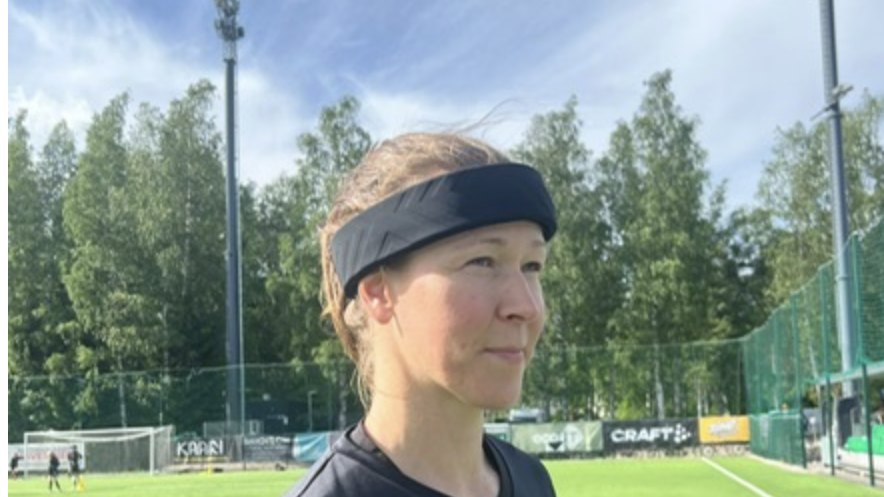
We are very grateful for having the opportunity to work with simply amazing people thriving to develop and improve; talented, dedicated, hard working and determined athletes; and, occasionally also, with legends. Tinja-Riikka Korpela is one of them. She is one of Finland’s most accomplished women’s football players and widely regarded as one of the best goalkeepers in Finnish football history. She played 18 years and 128 international matches in the Finnish national team, and is long-time captain of Finland’s women’s national team “Helmarit”. Having such prominent figure playing & training with the world’s 1st intelligent protective headband is a privilege.
If you don’t know her, herewith short introduction and some insights why she wants to be part of building towards better football, putting player’s health and safety 1st.
Name, sport and position:
Tinja-Riikka Korpela, football/(soccer), goaltender
Some career highlights, where do you play now and what lies in your future:
16 years playing abroad, I moved back to Finland a year a go and play now for Helsingin Palloseura (HPS) in women’s first league, Kansallinen Liiga. The goal for the team is to be in top 3, and my personal objectives are to stay healthy, enjoy playing football and give my team all I got. This may be my last season as professional athlete. I’m very interested in coaching, helping and developing young athletes. Looking forward to start UEFA GK B goalkeeper education this summer.
About concussions, brain health and safety:
I have been concussed (mTBI) several times during my career, and in 2021 I decided to start wearing protective headband in trainings and matches. Last concussion I had I got when I was playing in Switzerland, it was in the practice when a high speed ball bounced from the goal post to my head. I also sustained whiplash injury then – a neck sprain or strain caused by a sudden forceful back-and-forth movement of the head. One of the injuries the rapid and forceful impact forces on a head can cause, but protective headband cannot prevent.
About ACT Head Impact Tracker, the world’s first intelligent protective headband, and thoughts on football (soccer) players’ brain health and safety in general:
It is very important to me that impacts and forces to our, football/soccer goalkeepers, heads are measured and recognised. Even if we don’t do heading, ocassionally we do get hit by a high speed ball to the head, and jolts of head and neck are common when we go after and In front of the ball. So when I learned about ACT Head Impact Tracker and protective headband where the sensor could be seamlessly integrated I wanted to give it a go. The headband is easy to use and it is comfortable, the most important feature of course being that at least some of the direct impact forces on a head can be absorbed by it.
It feels as if the speed and forces in football (soccer) are increasing each passing year. Which means that also the high impact impacts, blow and jolts on a head are more and more frequent. I think it would be a good idea to consider using protective head bands more. At least I personally do worry, what the future might bring. What all those head injuries might have caused. There has been lots of research made on the cumulative repetitive impacts and events on a head, and what they may cause or contribute to – degenerative brain diseases is not a nice future prospect.
About giving back, data collection and researches
I love the fact that nowadays there is much more research on football (soccer) brain health and safety matters, and I’m very happy to be part of them. It is particularly important to me to build awareness and understanding on the goalkeepers on the pitch (too many times excluded) and on female athletes (vast majority of the research is conducted on males). So all initiatives on female footballers’ brain health and safety are highly regarded.
Last words
I hope all the players would understand that we have only one head and brain, and they are irreplaceable. If an arm, knee, finger, or ankle is injured, it can be fixed. But brain injuries can’t. You cannot control all that happens in sports and on the pitch, accidents will happen. But when we are more aware, know more, and do more (like wearing the protective headbands) – we can try to improve the chances of not being seriously injured.
Photo: Tinja-Riikka Korpela